A 90-day pilot on one crossing
No long-term commitment. In 90 days, your city gets a verified record of what its most problematic crossing actually costs.
What the pilot includes
Sensors installed
Sensor nodes (vibration, magnetometer and camera) on your target crossing, calibrated and running.
Live dashboard
Real-time crossing status and history for your staff.
Grant-ready report
Every blockage, with arrival, departure and duration, plus exports for a benefit-cost analysis.
Grant strategy support
We help your staff turn the data into an application narrative.
No railroad negotiations
All hardware sits outside the right-of-way, on your timeline.
Pilot timeline, from survey to data delivery
Site survey
Pick sensor spots on public infrastructure near the crossing.
Install
Sensors go in on public property, outside the railroad right-of-way.
Live access
Your engineers and dispatch see real-time status and early data.
Data delivery
Full incident log and report, ready for your application.
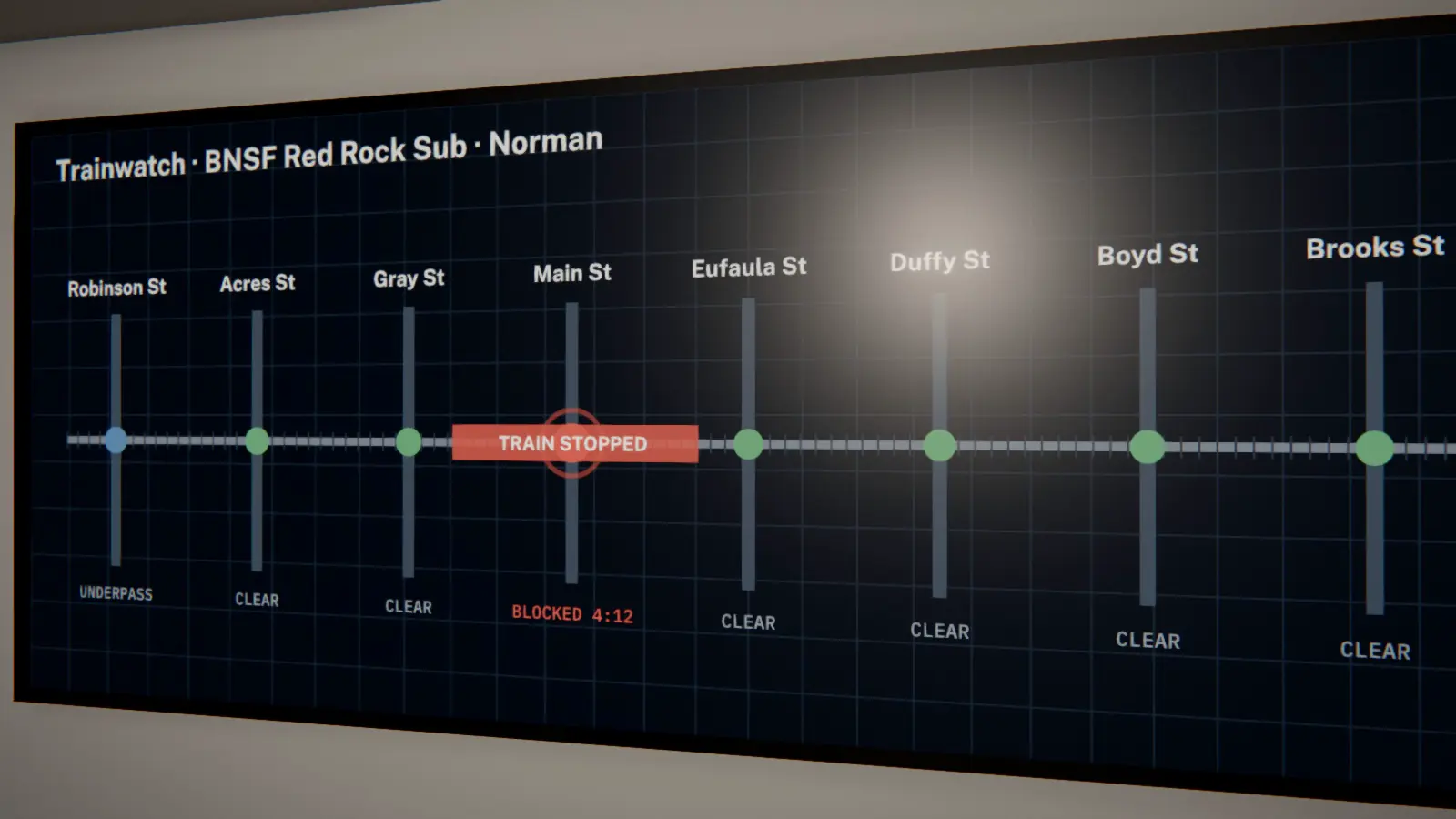
The dashboard in a dispatch room
Live status for the pilot crossing, weekly totals, the hours that hurt most, and an event log that exports straight into a grant application.
Procurement and pricing
A pilot is sized for small-purchase rules, and we're already set up on the portals cities use for formal solicitations.
Approved IonWave vendor
Ready to respond to solicitations posted through IonWave.
Verified on bid portals
Registered and verified on the municipal bidding portals cities use.
Paperwork on request
W-9 and state vendor certifications available when your purchasing team asks.
Backed by OU
Supported by the University of Oklahoma's Tom Love Innovation Hub.
Itemized cost for one crossing. Most pilots fall under small-purchase limits.
Issued by your city. Your terms and PO govern the work.
We start within days and confirm sensor spots with your engineers.
What directors ask
What does a pilot cost?
$3,500–$9,500 for one crossing over 90 days, depending on scope. Your written quote lists every cost (hardware, installation, dashboard access and the final report) before you commit. There are no recurring fees during the pilot, and it doesn't auto-renew: continuing after 90 days is a separate written quote. In Norman, purchases between $5,001 and $49,999 need three written quotes and contracts over $25,000 need City Council approval; Texas cities' formal-bid threshold has been $100,000 since September 2025.
How long until we have usable data?
We recommend at least 90 days to capture weekday, weekend and event patterns. Historical FRA records can be compiled on day one so you aren't starting from zero.
Congress may make railroads collect this data. Why do we need our own?
The BUILD America 250 Act, approved in committee but not law, would have railroads collect data at crossings blocked three or more times in 30 days. Your own record starts on day one, covers the crossings you choose, and lets you check railroad-reported numbers.
What happens to our data if we stop?
You keep it. At the end of the pilot you get a complete export in standard formats whether or not you continue, and we delete our copy on request.
How much staff time does it take?
Very little. The system runs unattended; your main task is reviewing the final report.
Let's talk about your crossing.
One conversation is all it takes to start. Tell us which crossing worries you most.
Your email app should open with your request.
If it didn't, email drew@trainwatch.us or call (214) 471-2988.